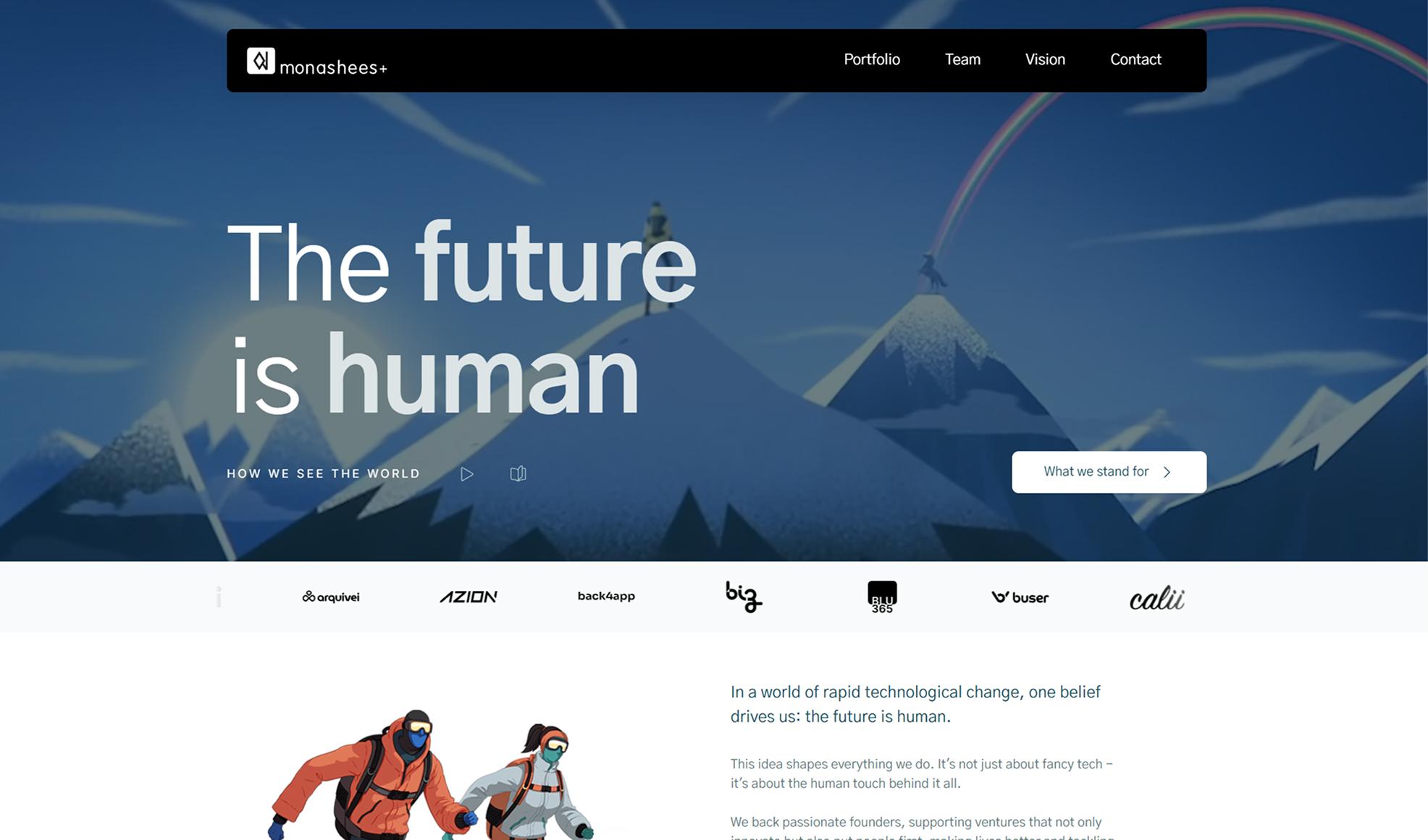
A venture capital website where every portfolio company and every team member has their own page, published by the monashees team straight from the CMS.
Next.js
React
TypeScript
Hygraph
GraphQL
Company
monashees
Role
Frontend & QA Engineer
Team
Insany team + monashees team
201234567890123456789
dynamic templates: company and person
101234567890123456789
form for founders
401234567890123456789
areas in the main menu
001234567890123456789
devs to publish a new investment
On this page
// 01
TL;DR
Problem01
Show a large, growing portfolio with the same quality for every company, introduce the team and open a channel for founders to apply for investment.
What I did02
A Next.js website with content in Hygraph: templates for each company page (board, investments) and each person page, plus an application form for founders.
Result03
Every portfolio company and every person got their own page, published by the team without a developer, and the structure held even after the site was redesigned.
// 02
The company
Founded in 2005 by Eric Acher and Fabio Igel, monashees describes itself as the first Silicon Valley–style VC in Latin America. It backs tech founders from seed to Series B, with offices in São Paulo, Mexico City and San Francisco.
Since then, it has invested in 150 companies, 12 of them unicorns, such as 99, Rappi, Loggi and Wellhub. That raises the stakes for the website: it is the storefront of one of the region's most relevant firms for founders, LPs and co-investors.
Portfolio
12 unicorns
Among the 150 companies backed since 2005
Timeline
2005
Founded
One of the pioneers of venture capital in Latin America.
120123456789012345678901234567890123456789funds: 10 early stage and 2 growth
501234567890123456789countries in Latin America
US$ 700MUS$012345678901234567890123456789012345678901234567890123456789Mraised in 2021
Figures published by monashees and the press. They belong to the firm, not to this project.
Part of the portfolio
99
Rappi
Loggi
Nubank
Wellhub
Creditas
Ualá
Tractian
Nomad
Neon
Loft
Addi
99
Rappi
Loggi
Nubank
Wellhub
Creditas
Ualá
Tractian
Nomad
Neon
Loft
Addi
// 03
Context
For a VC, the website has two jobs: attract founders and show credibility to founders, LPs, co-investors and the press. And a VC's strongest proof of credibility is its own portfolio.
Who uses it
FounderKnow whether monashees invests in companies like theirs, who is on the team and how to apply for investment.
LPs and co-investorsSee the track record, the portfolio companies and who sits on each board.
Press and marketFind information about portfolio companies, investments and the firm's people.
monashees teamPublish new investments and update companies and people in Hygraph, without filing a ticket with a developer.
// 04
Problem
The monashees portfolio is large and grows with every new investment. Each company has a description, a board, funding rounds and links, and keeping all of that in code would be slow and error-prone: an investment announcement can't wait for a deploy.
At the same time, every company needed the same level of presentation, with no first-class and second-class pages. And the founder who lands on the website wants to answer one question: does this VC invest in companies like mine? A wall of logos doesn't answer that.
// 05
Solution
The website is organized around Portfolio, Team, Vision and Contact. From the portfolio, each company leads to its detail page; from the team, each person leads to their profile. Founders who want investment have their own application form.
Companies and people are records in Hygraph, linked to each other. Detail pages are generated from those records, so the monashees team publishes a new portfolio company or a new person without touching the code.
A portfolio in the founders' voice
Instead of a grid of logos, the portfolio opens with the founders: each card brings together the company's brand, a photo of the founder and a quote about their entrepreneurial journey. The VC shows the companies and, at the same time, its relationship with the people behind them.
1
UI decisionThe color belongs to the companyEach card uses the portfolio company's brand color, so the grid feels varied without any company looking more important than another.
2
UI decisionFace and quoteThe founder's photo takes half of the card and the other half carries their quote, with name and role right below.
3
UI decisionSame component, different heightsThe card adapts to the length of the quote, and the staggered two-column grid absorbs those differences.
A page for every company
Each portfolio company has a detail page with the company description, the board (the monashees people who work with the company), the investment history and a link to its website.
Every page comes from the same template, fed by Hygraph fields. A new company is a new record in the CMS, and its page is born with the same quality as all the others.
01Portfolioevery portfolio company
02Company pagedescription and website
03Board and investmentsdata from Hygraph
04Person profilemonashees team
From portfolio to person: visitors pick a company in the grid, reach the detail page with board and investments and, through the board, move on to the profile of who works with the company.
Team and person pages
Each team member has their own profile, generated on the same principle as the companies. Since company and person are linked records in Hygraph, a company's board points to the profiles, and a person's profile shows the companies they work with.
The relationship is entered once and shows up on both sides, with no duplicated content and no risk of one page saying one thing and the other something else.
Applications for founders
Attracting founders is the reason a VC website exists, so the investment application has its own form, separate from general contact. Founders who arrived through the portfolio or the team find a direct path to present their company to monashees.
What founders get beyond the investment, with a shortcut to the portfolio right below.
The contact form, next to the map with the São Paulo and Mexico City offices.
One system for every page
Portfolio, Vision and Contact are built from the same pieces: the hero with a large title and a short text over the triangle background, the same typography and the brand green on buttons, icons and the active item.
On the full portfolio list, filters and search sit above the logo grid; on Vision, the firm's principles become a list where each item opens its text alongside.
The full portfolio list, with filters and search above the logo grid.
The firm's principles as a list: the active item turns green and shows its text alongside.
Hygraph and generated pages
Content comes from Hygraph over GraphQL, fetching only the fields each page uses: less data on the portfolio, the full record on the detail page. Next.js generates a route for each company and each person from the CMS records.
Each page's title, description and social preview also come from Hygraph fields, so a search for a portfolio company's name can lead to its page on the monashees website.
01Hygraphmonashees team edits
02ContentCompany · Person
03GraphQLonly each page's fields
04Next.jsa route per company and person
05Visitor
From Hygraph to the visitor: the team edits companies and people, Next.js fetches the content over GraphQL and generates a page for each record.
// 06
Trade-offs
Dilemma
Linking each logo straight to the company's website is simpler, but it takes visitors off the monashees website.
Options
External link to the company's website only
A detail page for each company, with the external link inside
Choice
A detail page for each company
Why
The VC keeps the story of the partnership (board, investments, people), visitors keep browsing the portfolio and each portfolio company becomes a monashees page in search results.
// 07
Learnings
What I'd do differently
Define rules for logos and photos in the CMS from the start (format, aspect ratio, background), which tend to be the biggest source of visual inconsistency in a portfolio grid.
Plan a portfolio search, which becomes a need as the number of companies grows.
What I took with me
A good content model multiplies the design. One well-thought-out page becomes dozens of consistent pages.
Relationships in the CMS keep navigation alive. Company ↔ person, entered once, connects the portfolio and the team in both directions.
Structure outlasts visuals. The website was redesigned later, but the portfolio, the company and person pages and the form stayed.